

Data Center Architecture Solution
- Category: Solutions
- Publish Time: 2021-04-13 17:01:16
- Views: 0
1 Classic Data Center Construction Solution
1.1 Solution Introduction
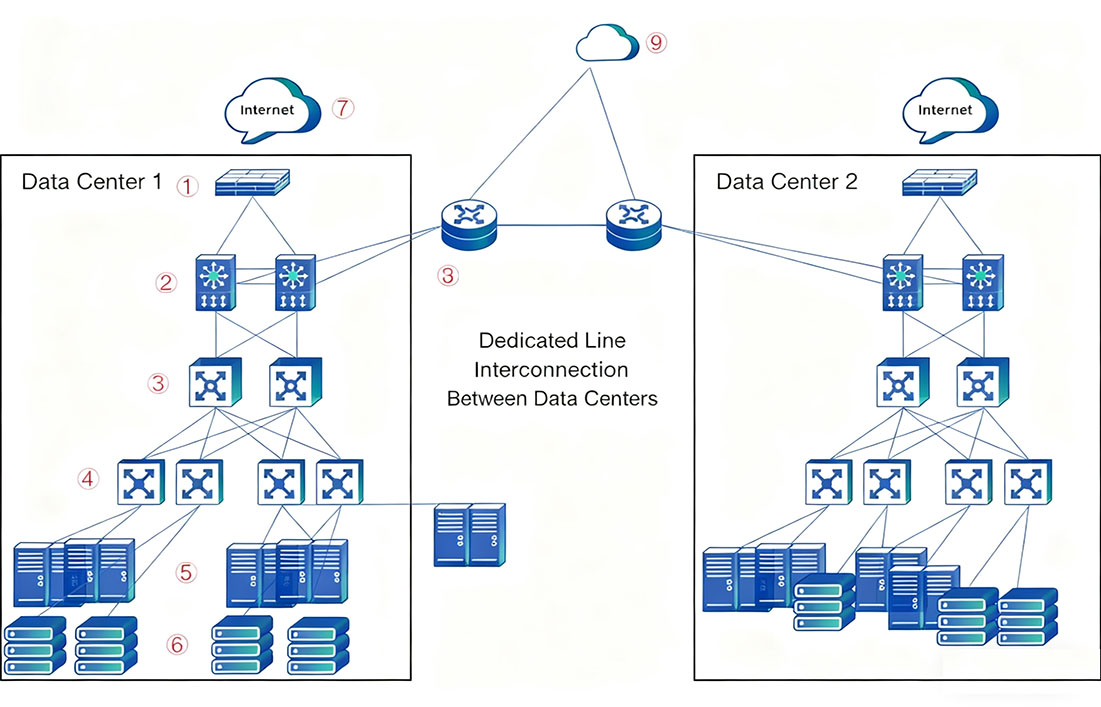
In today's digital wave, regardless of how emerging technologies develop, ICT infrastructure remains indispensable. As one of the most important infrastructures in data centers, traditional servers and dedicated storage are still the most crucial foundation for enterprise services. However, different businesses and scenarios have varying requirements for servers. In response to these situations, servers must possess high scalability and customization capabilities.
For different scenarios, our company provides dedicated servers and storage solutions to meet various needs, covering areas such as big data, high-density computing, blade-based hyper-converged servers, high-performance storage, and tape backup devices, offering comprehensive solutions and customized equipment services for enterprise clients.
1.2 Solution Topology
1.3 User Benefits
① Full Scenario Support: For different customer needs, we can interface with most mainstream vendors to provide scenario-based equipment with the best cost-performance ratio, covering virtually all scenarios. For customized scenarios, we can also provide customized equipment with optimal cost-effectiveness.
② Complete Lifecycle Support: During the equipment lifecycle, in addition to manufacturer warranty and warranty extension, we provide rapid online consultation and offline support.
③ Expert Service: We have a professional expert team and business team, providing rapid expert services for your data center from technical to business aspects.
④ Quick Warranty and Response: We maintain a comprehensive spare parts inventory, fully capable of providing faster parts replacement and warranty service than the ordering cycle, typically resolving issues and providing new parts within 24 hours.
2 Distributed Storage
2.1 Solution Introduction
Storage has evolved from early expensive hard drives to today's multi-controller storage, becoming increasingly powerful. As business requirements continue to rise, there are higher demands for storage IOPS, cache, and processing speed. However, dedicated centralized storage is usually expensive and highly homogeneous, leading to increased enterprise costs and making data centers costly and difficult to expand.
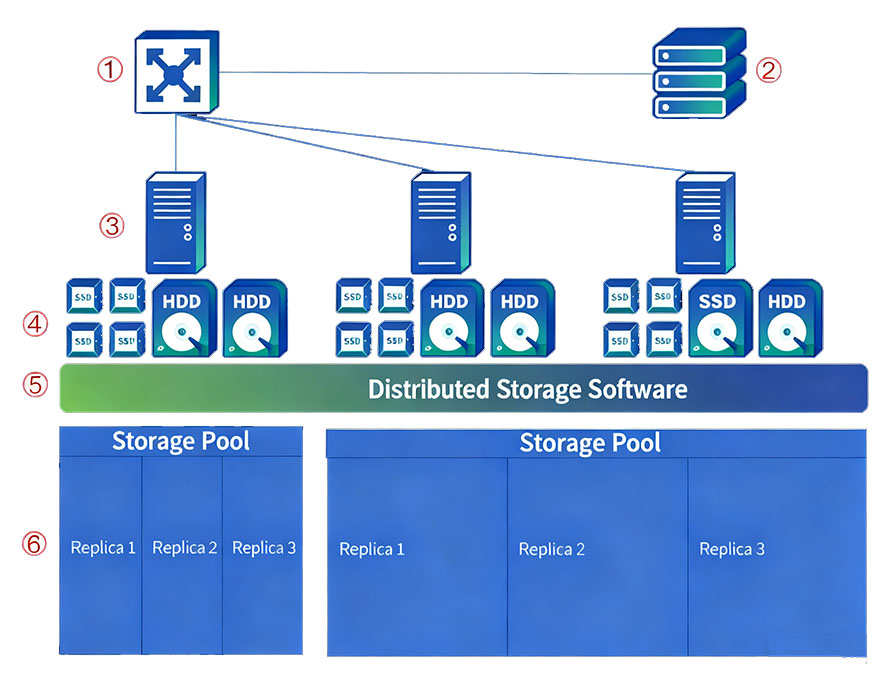
Distributed storage, through Software-Defined Storage (SDS), reorganizes server hard drives through software, achieving the same performance as professional storage while enabling heterogeneity and reducing enterprise costs. Additionally, distributed storage supports data protection and redundancy through multiple copies and erasure coding. Furthermore, it supports tiered storage, structured and unstructured data storage pools, and heterogeneous disaster recovery and backup. Most importantly, distributed storage offers better elastic scalability than dedicated storage, allowing storage space expansion without purchasing dedicated storage, thanks to its excellent and rational distributed architecture.
2.2 Solution Topology
2.3 User Benefits
① Cost Optimization: Distributed storage integrates server data disks through software and supports all-HDD, all-flash, and hybrid configurations (using SSDs as high-speed cache). Expected performance can be achieved without purchasing dedicated storage, resulting in low construction costs.
② Heterogeneous Integration: Software-defined distributed storage is not constrained by a single vendor, enabling heterogeneous deployment and greatly reducing the risk of deep vendor lock-in, with low expansion costs in the future.
③ Heterogeneous Disaster Recovery and Backup: Distributed storage supports backup to third-party tape libraries, centralized storage, and other devices.
④ Tiered Storage: Distributed storage can create multiple storage pools, with each pool configurable for hybrid, all-flash, or all-HDD modes, and different redundancy backup strategies including multiple copies and erasure coding. These features enable rational division of business storage areas, reduce resource waste, and improve storage performance.
⑤ High Performance: Distributed storage combines multiple independent devices into clusters, using algorithms to distribute load reasonably among cluster servers, breaking through single-node performance limitations.
⑥ Data Consistency: Distributed storage data maintains strong consistency, where a complete I/O operation means all copies are fully written without differences.
⑦ High Scalability: Distributed storage offers convenient horizontal expansion - when adding storage resources to the cluster, simply add the device to the cluster.
3 Hyper-converged Solution
3.1 Solution Introduction
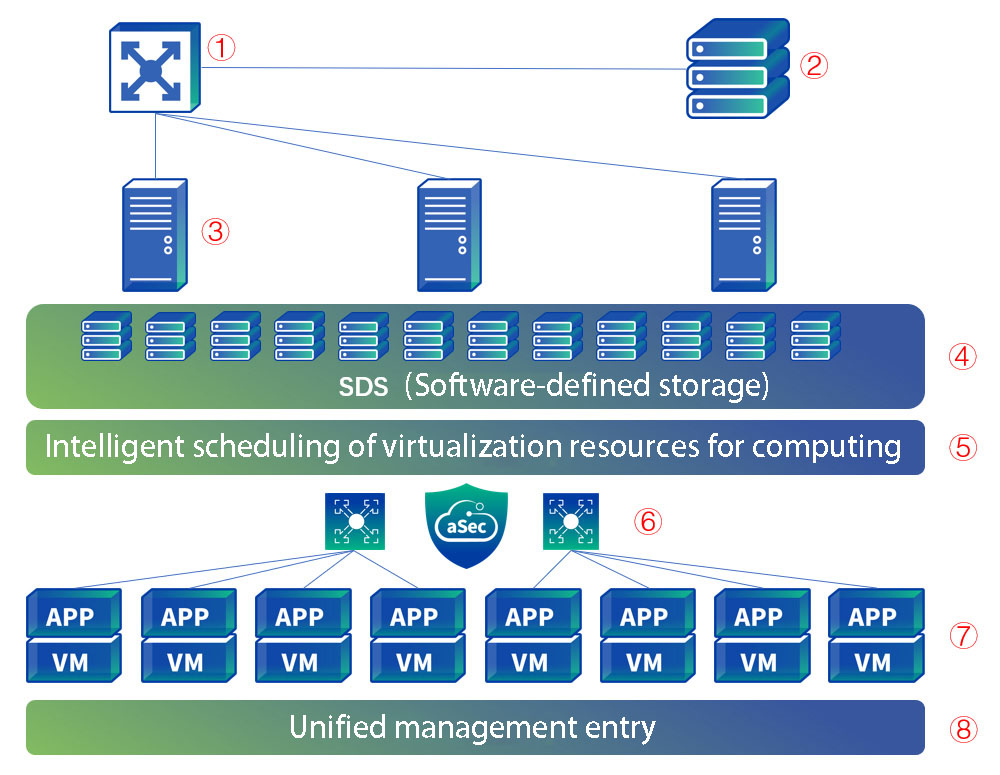
Many people feel confused when they first hear this term, just like cloud computing, but in fact, hyper-convergence has become a highly competitive field in the IT industry in recent years. To explain it simply, hyper-convergence and cloud computing share the same basic philosophy - everything is a resource and everything can be quantified. Hyper-convergence refers to the virtualization and unified management of computing resources, storage resources, and network resources. So what's the difference between hyper-convergence and cloud computing? I prefer to understand hyper-convergence as a subset of cloud computing. While sharing the same basic principles, hyper-convergence is an enhancement of existing cloud platforms. Its main concept is smooth expansion, decoupling computing, storage, and network resources from hardware to achieve IT infrastructure convergence, all defined by software. Its deployment is as simple as plugging in power.
Compared to cloud, hyper-convergence is simpler and ready to use out of the box. In terms of infrastructure, hyper-convergence is decoupled, requiring no specialized hardware to achieve computing, storage, and network functions. For operations and maintenance, low-cost learning investment can achieve unified management, reducing operational costs and personnel expenses. In terms of delivery, hyper-convergence is delivered and operated as complete units. For capacity expansion, the smooth expansion feature makes hyper-converged architecture expansion simple and convenient.
ZCZYTECH's hyper-converged solution selects the industry's top vendors for enterprises, providing highly available and reliable infrastructure. Disaster recovery and hot backup implementation is simple and quick, while visualization management and monitoring greatly improve usability.
3.2 Solution Topology
3.3 User Benefits
① Cost Optimization: Reduce IT infrastructure costs, allowing small and medium enterprises to enjoy cloud computing benefits and supporting stable business development.
② Heterogeneous Integration: Software and hardware can be decoupled, reducing vendor lock-in. Third-party virtualization compatibility is also supported.
③ Multi-tenant (Business) Resource Delivery: For large and medium-sized project teams with multiple businesses, using a single resource pool can cause various issues. The integrated multi-tenant functionality perfectly solves this through user permission management to deliver different resources to business teams.
④ Real-time and Local Alert Support: Integrated comprehensive alert pages and large screen displays meet all enterprise alert requirements without the need for a separate operations monitoring system. Additionally, the platform supports SMS, context menu, and APP alerts.
⑤ Unified Management and Easy Operations: Fully graphical Web management portal integrating security, alerts, operations management, automation, application load balancing, business HA, and other capabilities.
⑥ Distributed Storage and Heterogeneous Disaster Recovery: Distributed storage builds a highly available storage cluster at low cost through software definition. The storage cluster supports structured and unstructured storage, multiple copies and erasure coding for different business data redundancy needs, supports failure domains and protection domains, and heterogeneous disaster recovery.
⑦ Compatible with Other Vendor Virtualization Platforms: The hyper-converged platform supports managing third-party or open-source virtualization platforms, and can repackage their virtual machines into the platform's format, enabling perfect migration of third-party or open-source virtual machines.
4 Server Virtualization
4.1 Solution Introduction
Traditional single servers typically configure hardware parameters based on business attributes and expected user volume, but this approach comes with high costs. For example, when a business requires multiple services, one service might need a server with just one CPU but lots of memory and storage space, while other services have different configuration requirements, and some might even be complementary. With the same configuration, multiple servers are certainly much more expensive than a single server, so why not configure all business needs on one or a few servers? Of course, this is possible, and virtualization is an excellent solution. However, the challenge is that open-source virtualization applications are standalone, and open-source suites are loosely coupled with low correlation, making it impossible to form productivity. Even after deployment, operations and management are extremely difficult, increasing enterprise staffing costs.
In traditional IT, server resource utilization is far below actual performance, but due to issues like undefined resource boundaries and indistinguishable runtime environments, adding data center equipment becomes necessary. Such low efficiency brings unnecessary cost burdens to enterprises, so how do we solve this problem?
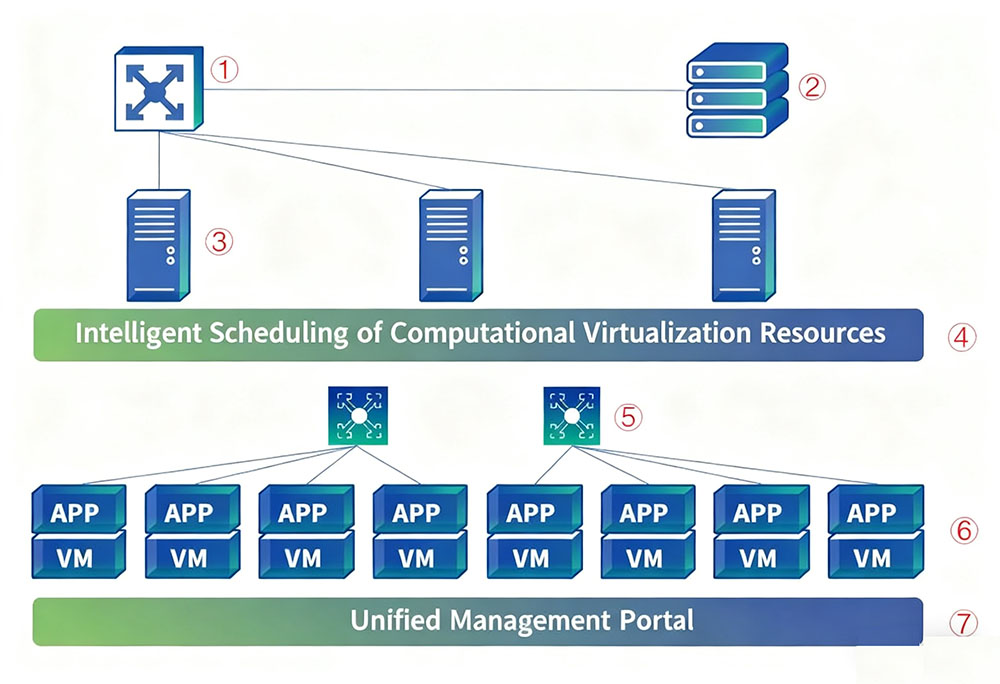
While virtualization solutions rely on server computing resource virtualization, open-source virtualization applications are difficult to maintain, and implementing unified operations management requires secondary development, presenting a challenge for enterprises. ZCZYTECH's virtualization solution provides commercial virtualization support, combining industry-leading virtualization vendors to offer unified management, visual monitoring, and continuous integration commercial virtualization solutions. This helps enterprises reduce equipment costs, minimize space waste, achieve convenient management, faster deployment, and simple disaster recovery. Additionally, it improves business flexibility through dynamic resource allocation and scheduled tasks, supporting heterogeneous integration and version iterations.
4.2 Solution Topology
4.3 User Benefits
① Cost Optimization: Reduce IT infrastructure costs, allowing small and medium enterprises to enjoy cloud computing benefits and supporting stable business development.
② Virtualization-based Resource Isolation: Through virtualization technology, forcefully define service resource usage boundaries, making resource allocation more flexible. Each virtual machine is a complete computing unit, with full isolation between virtual machines.
③ Multi-tenant (Business) Resource Delivery: For large and medium-sized project teams with multiple businesses, using a single resource pool can cause various issues. The integrated multi-tenant functionality perfectly solves this through user permission management to deliver different resources to business teams.
④ Real-time and Local Alert Support: Integrated comprehensive alert pages and large screen displays meet all enterprise alert requirements without the need for a separate operations monitoring system. Additionally, the platform supports SMS, context menu, and APP alerts.
⑤ Unified Management and Easy Operations: The virtualization platform supports managing third-party or open-source virtualization platforms, and can repackage their virtual machines into the platform's format, enabling perfect management and migration of third-party or open-source virtual machines.
5 Private Cloud
5.1 Solution Introduction
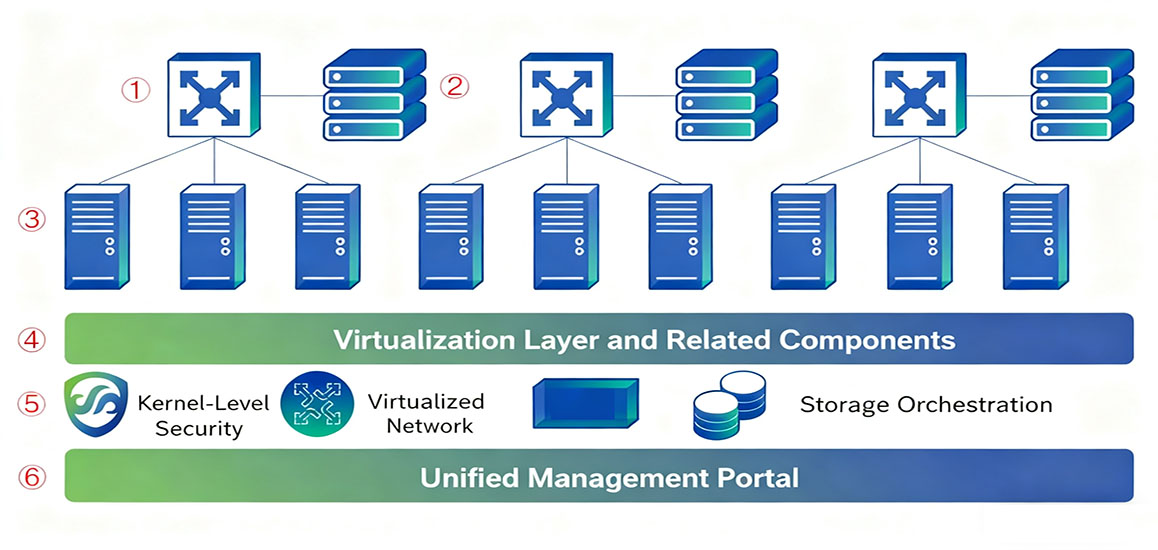
From the perspective of cost optimization and resource utilization, cloud computing has become a standardized infrastructure for the internet, and migrating business to the cloud has become a consensus. However, whether building a cloud data center from scratch or transforming a traditional data center into a cloud data center, many factors need to be considered. Today's existing data centers can no longer meet modern internet demands, while cloud data centers are becoming an industry consensus, and data centers are facing new challenges in the new era.
Our company provides both open-source and commercial private cloud solutions, tailored to customer needs. Through deep understanding and practical experience with cloud platforms, we can provide customized development requirements and deliver a unified management, cost-optimized customized solution for our customers.
5.2 Solution Topology
5.3 User Benefits
① Cost Optimization: The initial investment cost of private cloud is not significantly different from traditional data centers, but there are huge differences in subsequent operations management and capacity expansion, thanks to the efficient resource utilization of private cloud. Additionally, in terms of future technology upgrades, private cloud has unparalleled advantages over traditional data centers.
② Virtualization-based Resource Isolation: Through virtualization technology, forcefully define service resource usage boundaries, making resource allocation more flexible. Each virtual machine is a complete computing unit, with full isolation between virtual machines.
③ Multi-tenant (Business) Resource Delivery: For large and medium-sized project teams with multiple businesses, using a single resource pool can cause various issues. The integrated multi-tenant functionality perfectly solves this through user permission management to deliver different resources to business teams.
④ Real-time and Local Alert Support: Fully graphical Web management portal integrating security, alerts, operations management, automation, application load balancing, business HA, and other capabilities.
⑤ Pluggable Components and Modules, On-demand Configuration: Commercial cloud platforms have comprehensive components and modules, while popular open-source cloud platforms have mature communities and complete ecosystems. These components and modules can be customized for addition and can undergo secondary development and customization.
⑥ Unified Management and Easy Operations: Cloud platforms can achieve unified management of data centers, enabling unified operations management, asset management, reporting, and other capabilities. For operations, cloud platforms have many reliable components that simplify maintenance complexity and provide certain automation capabilities.
6 Hybrid Cloud
6.1 Solution Introduction
As one of the driving forces of modern internet, cloud computing is most commonly known through public cloud. Public cloud is a commercialized scenario of cloud computing, allocating resources to tenants through leasing while ensuring mutual non-interference. Today, the anytime, anywhere, pay-as-you-go model of public cloud has become deeply ingrained, and in most small and medium enterprises, entrepreneurs or technical directors prefer to purchase public cloud resources as a starting point for company operations. This type of resource purchase means companies don't need to spend substantial costs upfront to build their initial data center, but can instead complete their business development process on public cloud with minimal cost. Public cloud integrates numerous services (we don't distinguish between PaaS and SaaS here, as these concepts have become increasingly blurred), with complete open API interfaces and libraries, greatly shortening business launch cycles.
As enterprises continue to develop, questions arise: Is enterprise data stored on public cloud secure? On non-bare metal architecture servers, which other businesses are running alongside my services? These issues have gradually become concerns for technical directors! Moreover, frequent security incidents in public cloud today have raised further worries.
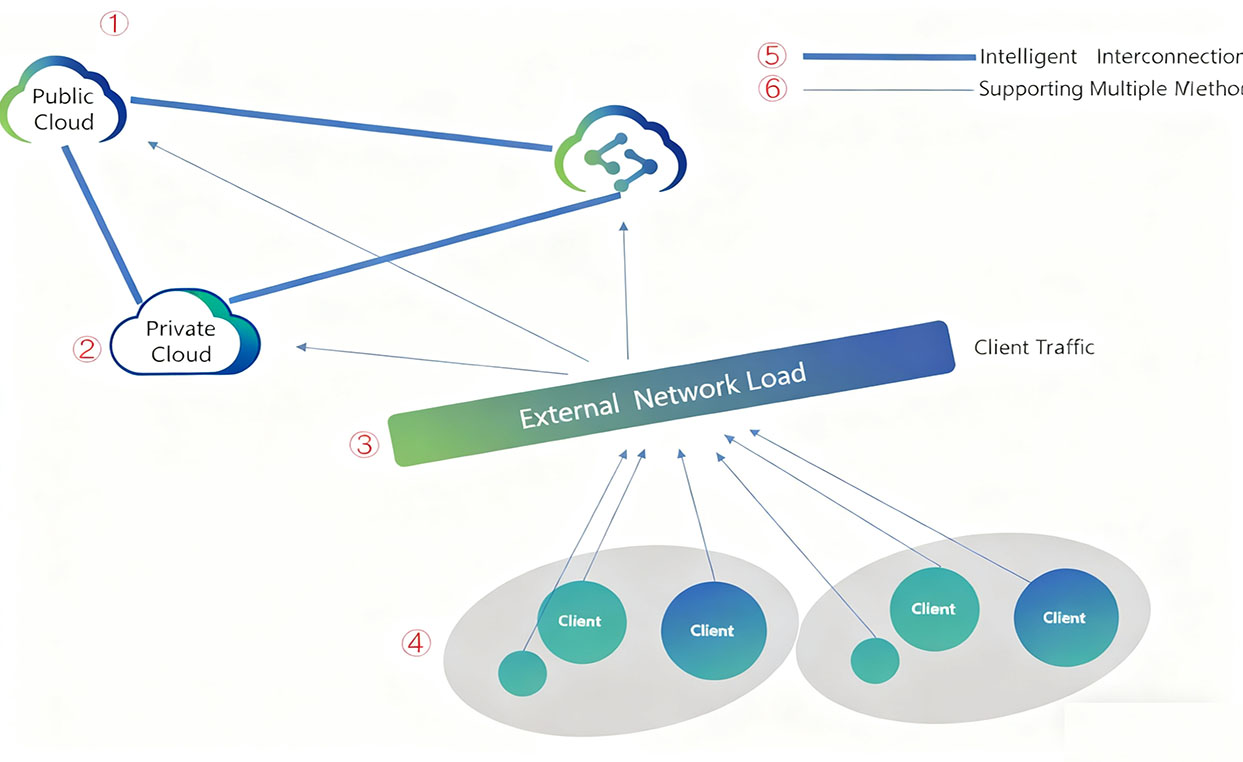
Meanwhile, enterprises that previously owned large and medium-sized private clouds also hope to enjoy the benefits of public cloud to optimize costs, development and operations complexity, and shorten business launch cycles. However, data security remains an unavoidable issue. Thus, hybrid cloud has emerged as an excellent solution.
For different business scenarios and environments, hybrid cloud solutions require extremely careful consideration. We will develop more refined solutions based on customer environments, considering aspects such as data storage location and load balancing between local and cloud. Additionally, we maintain good relationships with various public cloud providers and will propose hybrid cloud solutions in collaboration with cloud vendors.
6.2 Solution Topology
6.3 User Benefits
① Lower Cost Investment: Compared to obtaining resources entirely through private cloud, hybrid cloud can save costs through the public cloud portion. When temporary business needs or traffic surges lead to insufficient hybrid cloud resources, you can expand resources by purchasing public cloud resources without acquiring private cloud infrastructure (servers, storage, switches, etc.).
② Autonomous and Secure Business Data Control: Critical data and business data stored in local private cloud are more secure than in public cloud, while still allowing necessary data backup and redundancy through public cloud.
③ Public Cloud Elasticity: Public cloud offers resources as commodities, not just common resources like computing and storage, but also quantified PaaS and SaaS offerings. Therefore, you can obtain expected resources and various service APIs and development libraries at minimal cost.
④ Open Libraries and APIs for Cloud Service Integration: Business iteration speed increases yearly, and adapting to new ecosystems and markets might require significant R&D investment. Public cloud, through service quantification, provides numerous mature services tested by years of market experience.
⑤ Rapid Expert Service: Public cloud platforms are supported by strong technical teams, with most becoming comprehensive solution providers while offering extensive knowledge bases. Thus, you can learn vast content on public cloud platforms and receive 24/7 expert service when needed.
⑥ Automation Empowerment: Public cloud platforms provide integrated automation tools and efficient icons and management portals, enabling automated operations across various levels with capabilities for discovery, alerts, self-healing, and logging. Additionally, cloud platforms offer localized alert support through SMS, context menus, mobile apps, etc.